
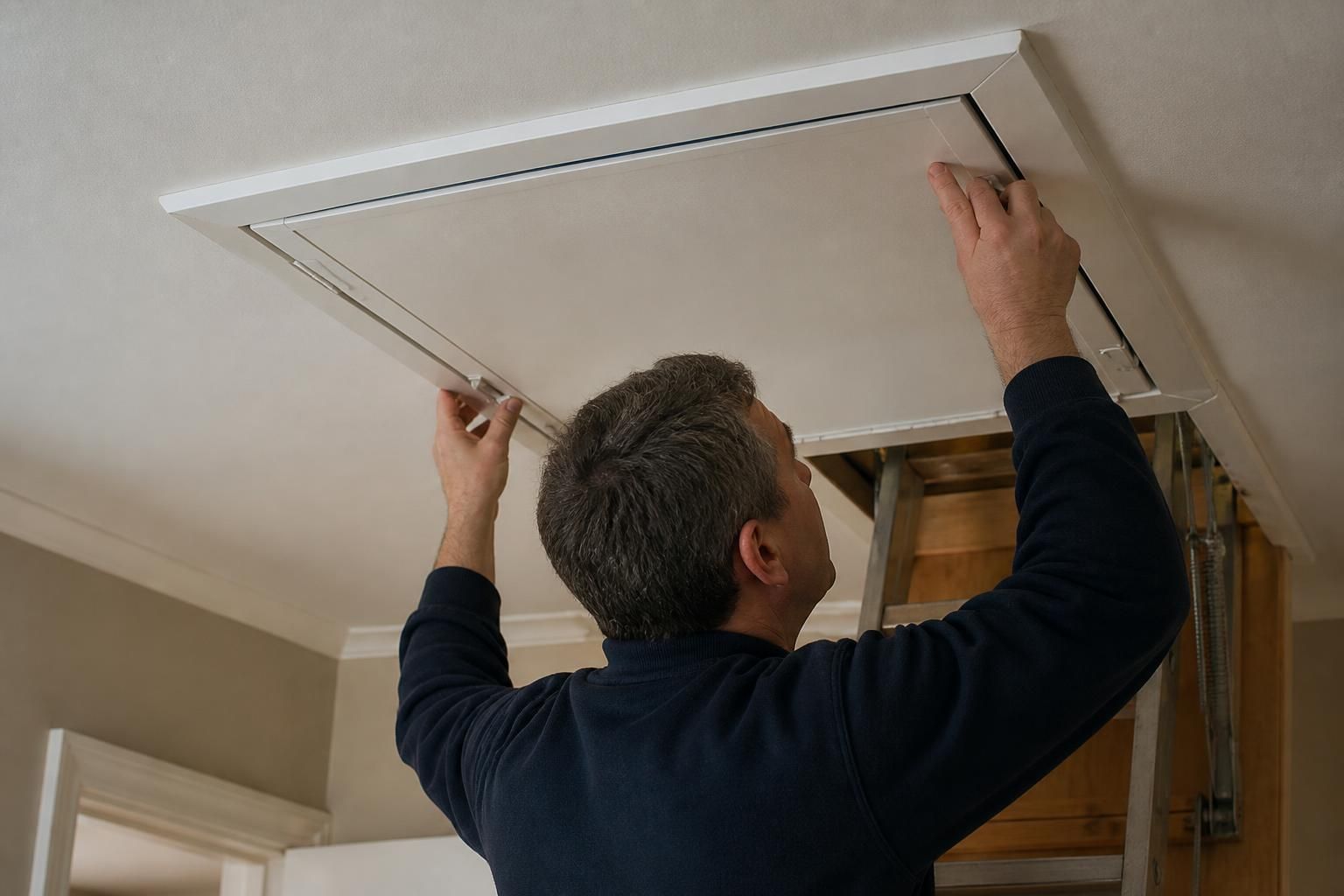
How is a replacement loft hatch sealed against draughts?
A replacement loft hatch is sealed against draughts by fitting the frame squarely and using a continuous compression seal around the hatch perimeter. An insulated hatch panel then helps reduce heat loss, provided the surrounding ceiling opening is sound and the hatch closes firmly.
A draught-resistant loft hatch depends on controlling air movement at every junction, not simply adding insulation to the panel. The installer must make the hatch, frame, ceiling and surrounding insulation work together as one uninterrupted barrier.
Air can enter through small gaps around the frame, at hinge points, beside the latch or between the hatch and its bearing surface. Dust, loose plaster, uneven edges and layers of old paint can prevent the seal from making consistent contact. We inspect these areas before fitting and remove material that would interfere with closure.
The fixing method also affects draught performance. Screws must hold the frame without pulling it out of alignment, while packers may be needed where the ceiling opening has minor irregularities. A decorative trim can cover the joint, but it should not be treated as the primary air seal.
The latch needs enough adjustment to hold the panel evenly against the sealing surface. If it is too loose, air may pass through one side. If it is too tight, the panel or frame can distort and make operation difficult. Hinges must allow the panel to close fully without fouling the frame.
Suitable airtight sealant or sealing tape may be used at the junction between the frame and ceiling, depending on the construction. The material must adhere to clean surfaces and remain compatible with the hatch and surrounding finishes. Expanding foam alone is not a substitute for a properly formed junction.
Insulation above the hatch should meet the surrounding loft insulation without preventing the panel from opening. Gaps in this area can create a cold edge and encourage heat loss, even when the hatch itself closes correctly. Insulation must not obstruct the latch, hinges or ladder mechanism.
- We check that the panel closes against the full sealing area.
- We inspect the frame-to-ceiling junction for visible gaps or movement.
- We check that the latch holds the panel evenly.
- We confirm that insulation does not prevent proper closure.
- We look for daylight around the closed hatch from the loft side.
A simple tissue check can indicate unwanted air movement around the closed perimeter, although it does not replace an inspection of the installation. A hatch that shifts when pressed, rattles during use or leaves a visible gap needs adjustment or remedial work.
Draught sealing and condensation control are related but different. Sealing reduces uncontrolled air movement between the home and loft. It does not remove the need for suitable loft ventilation or correct moisture management.
Loftopia can assess the existing opening and specify a replacement hatch with the appropriate sealing and insulation details. The aim is a hatch that closes securely, limits draughts and remains practical to use.

The draught seal is a serviceable part of the hatch assembly. If it becomes flattened, split or detached, it may no longer maintain contact around the full perimeter when the panel closes.
Check the seal during routine loft access and keep paint, dust and stored items away from the contact surface. Replacing a damaged seal can improve closure, but a distorted frame or loose fixings may need attention first.