
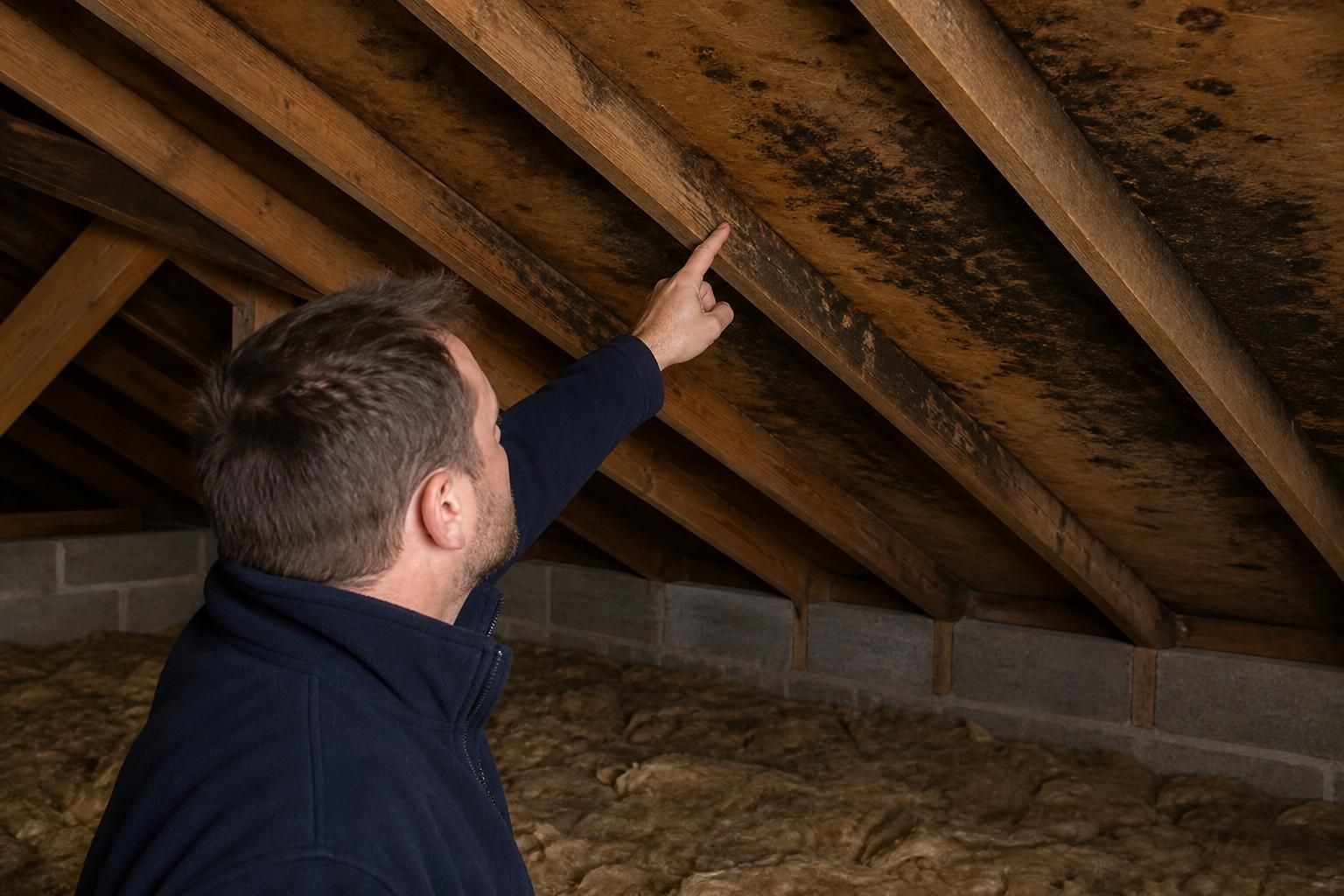
Can loft insulation condensation damage roof timbers?
Loft insulation does not usually damage roof timbers itself, but condensation can form when warm, moist air reaches cold timber surfaces.
Persistent moisture may encourage mould and timber decay, so investigate ventilation, air leakage and roof defects before boarding the loft.
Yes, persistent condensation can damage roof timbers, although loft insulation does not normally cause the damage by itself. Moisture must remain within or against timber before mould growth or decay becomes a concern.
Roof timbers can tolerate normal changes in humidity. Problems develop when warm, moist air repeatedly reaches cold rafters, trusses, joists or roof decking. Water vapour can then condense into droplets or raise the timber’s moisture content.
Short-lived surface dampness may leave staining or mould without immediately weakening the wood. Continued wetting creates more serious conditions for fungal decay, which can reduce timber strength over time.
Condensation damage usually develops gradually. The visible signs may appear after the underlying moisture problem has been present for some time.
- Dark or spreading stains on rafters, trusses or roof decking.
- White, green, black or grey mould on timber surfaces.
- A persistent musty smell within the loft.
- Soft, crumbly, cracked or distorted timber.
- Timber that feels unusually damp compared with nearby areas.
- Rusting nails, fixings or metal brackets around affected sections.
- Water droplets or frost on cold mornings.
Surface mould does not automatically mean that structural decay has occurred. A professional inspection can distinguish superficial growth from timber that has lost strength.
Several conditions can increase the risk around insulated lofts. Deep insulation can make the roof space colder, particularly when it blocks intended airflow at the eaves. Warm air escaping through gaps can then meet colder roof components.
Common air leakage points include the loft hatch, ceiling penetrations, recessed fittings, pipe routes and gaps around ducting. Bathroom or kitchen extract air entering the loft can add substantial moisture.
Roof defects create a different form of dampness. Missing tiles, damaged underlay, defective flashing and overflowing gutters can wet timber directly. These defects should not be treated as condensation without checking the roof covering.
Blocked ventilation can also restrict the movement of air beneath the roof covering. Insulation should not be pushed tightly into eaves ventilation routes where those routes are needed.
Condensation may affect different timbers in different ways. Rafters and trusses can become damp where moist air reaches the underside of the roof. Ceiling joists may remain cooler where insulation covers them.
Timber decay requires investigation because its appearance does not always show how far the problem extends. A surveyor may examine moisture patterns, ventilation, roof defects and the condition of structural members.
They may use a moisture meter as part of the assessment. Readings provide useful evidence, but they need interpretation alongside timber type, location and recent weather.
Do not cover stained or suspect timber with loft boards before identifying the cause. Boarding can restrict access and make later inspection more difficult.
Raised flooring can provide storage above insulation, but it should not conceal unresolved dampness. The supporting arrangement must also avoid damaging roof components or compressing insulation unnecessarily.
Before storage work, check the following points:
- Roof coverings and flashings are intact.
- Eaves ventilation paths remain open where required.
- Extract fans discharge outside the building.
- Ceiling penetrations do not allow excessive warm air into the loft.
- The loft hatch closes properly and limits unwanted air movement.
- Suspect timber receives a professional assessment.
Improving ventilation alone may not resolve condensation if warm air continues to escape from the rooms below. Air leakage and moisture sources need attention together.
Do not apply timber treatment as a substitute for finding the moisture source. Treatment may address a symptom while condensation, a leak or restricted airflow continues.
Minor mould should be handled carefully because disturbing spores can spread them. Avoid dry brushing affected areas, and seek appropriate advice for extensive growth or persistent dampness.
Urgent professional advice is appropriate when timber feels soft, breaks away easily, shows deep cracking or supports roof components. Movement, sagging or widespread staining also warrants prompt investigation.
Once the cause has been addressed, continue checking the loft during colder weather. Look for renewed droplets, staining, mould or musty odours around previously affected areas.
Loftopia can discuss how condensation findings affect raised boarding, insulation and access work. We can help you consider the order of remedial work before storage improvements begin.
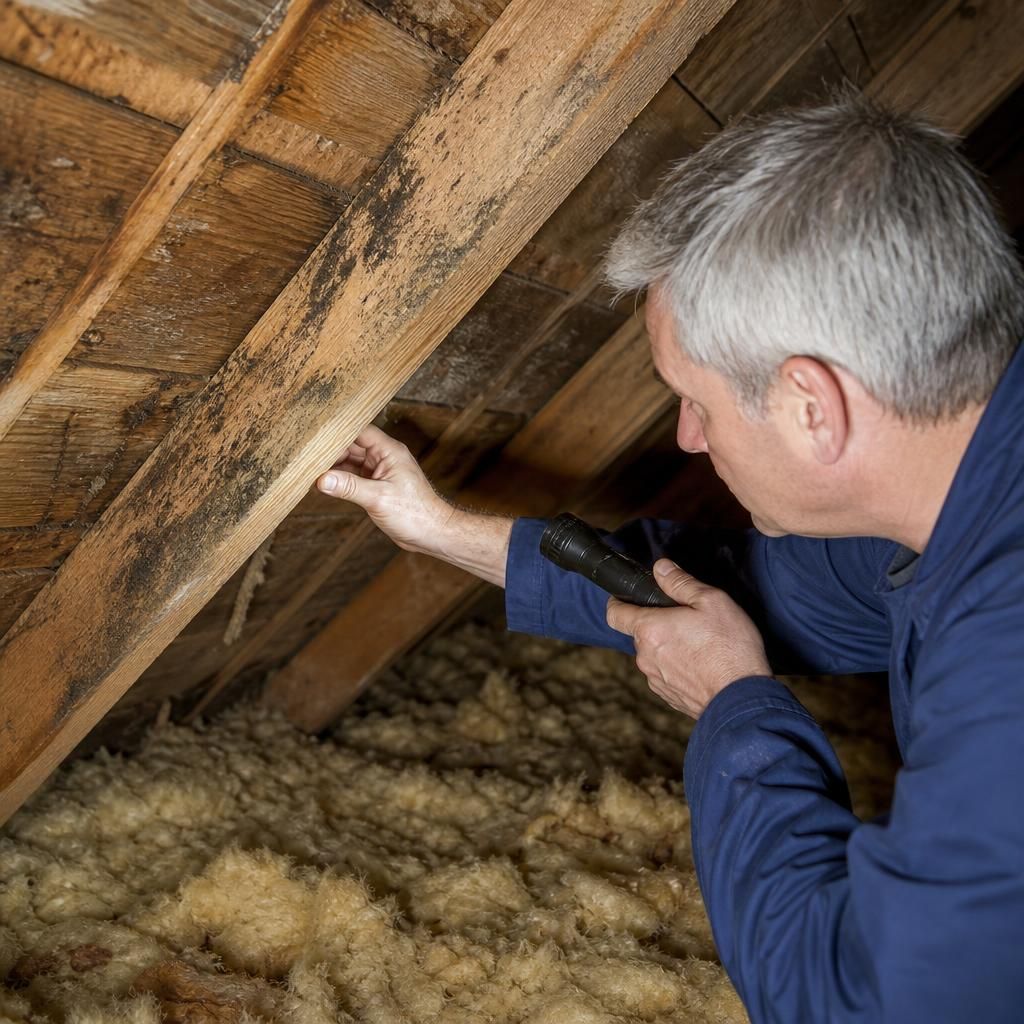
Roof timbers can appear sound from the loft side while moisture remains on concealed faces or within joints. An isolated photograph cannot establish whether condensation has affected the timber’s strength.
An inspection should consider timber surfaces, joints, fixings and nearby roof details together. This helps separate superficial staining from damage that could affect later storage work.