
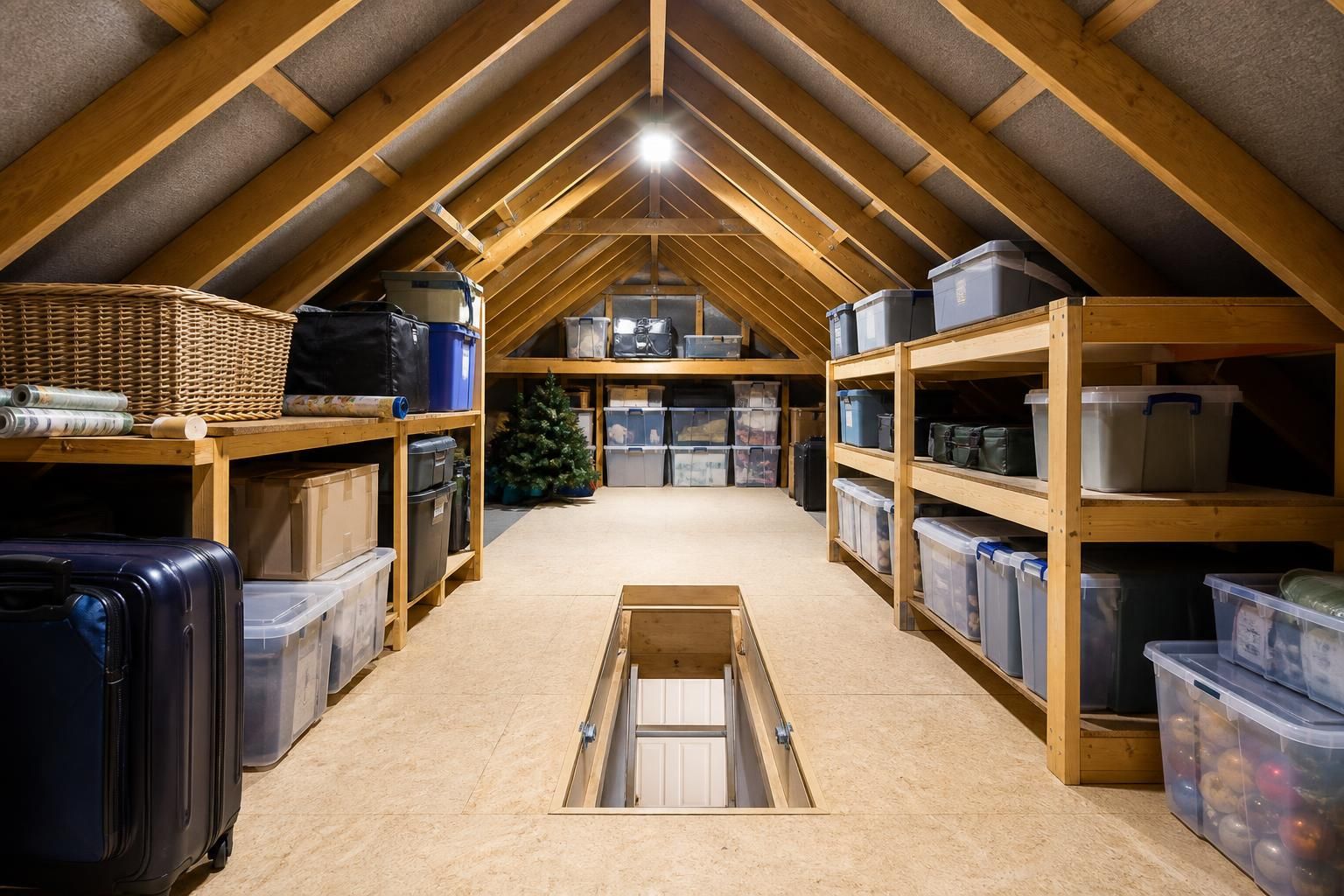
How does loft lighting affect organisation?
Good loft lighting makes stored items easier to identify, helps you keep categories in their designated places and reduces disruption when searching.
It also supports safer movement around boxes, shelving and access points, allowing you to plan storage around visible routes rather than placing items wherever space remains.
Loft lighting affects organisation by showing how storage is arranged, where space remains usable and which areas need clearer definition. A considered lighting plan can make the loft easier to manage without encouraging storage in unsuitable areas.
Light should support the layout rather than simply illuminate the centre of the floor. A central fitting may leave shelving, eaves storage and spaces beside the hatch in shadow. Positioning fittings to cover the main storage zones gives you a clearer view of the whole arrangement.
Consider the following when planning lighting around stored items:
- Shelving: Mount or position lighting so shelves do not shade one another. Light directed along shelving makes labels and container contents easier to distinguish.
- Eaves: Low-level areas often need separate illumination because roof slopes can obstruct light from a central fitting.
- Access routes: Keep switches and fittings clear of the ladder opening, boarded walkways and stored items.
- Storage zones: Use lighting to distinguish areas for seasonal decorations, luggage, household paperwork and less frequently used belongings.
- Openings and services: Avoid placing fittings where they obstruct access to ventilation, wiring, tanks, pipes or inspection points.
Lighting can also influence the type of storage you choose. Deep shelving may create darker lower sections, while tall boxes can block light from reaching items behind them. Open-front shelving or shallower containers may preserve visibility across the arrangement.
Glare matters as much as brightness. A fitting aimed directly towards the ladder or across a reflective storage box can make it harder to see. Diffused fittings and carefully directed beams usually give more even illumination than a bare, exposed bulb.
Lighting controls should match how the loft is used. A switch near the access point allows you to illuminate the area before stepping onto the flooring. Additional switches or separately controlled fittings can help when the loft contains distinct storage zones.
Use lighting to support an agreed storage plan, rather than allowing every available area to become a storage area. Maintain clear space around the loft hatch, ladder, electrical equipment and household services. Lighting cannot make an unsuitable loading area safe.
Electrical work in a loft needs appropriate planning because insulation, timber, cables and stored contents occupy the same confined space. A qualified electrician should assess the fitting, wiring route and positioning. Loftopia can include lighting within Loft Storage & Accessories when planning a wider loft storage arrangement.
Lighting also helps you review organisation over time. If one zone becomes difficult to illuminate, it may contain too many items or use containers that are too tall. Repositioning the storage can restore visibility without adding more fittings.
A practical lighting review should therefore check:
- Which storage areas remain shaded after the main fitting is switched on.
- Whether shelving or containers block light from reaching lower levels.
- Whether switches can be reached safely from the access point.
- Whether fittings leave services, ventilation and inspection areas accessible.
- Whether the arrangement still works after seasonal items are added or removed.
Good loft lighting does not replace a planned layout. It makes the planned layout easier to assess, maintain and adapt as the contents of the loft change.
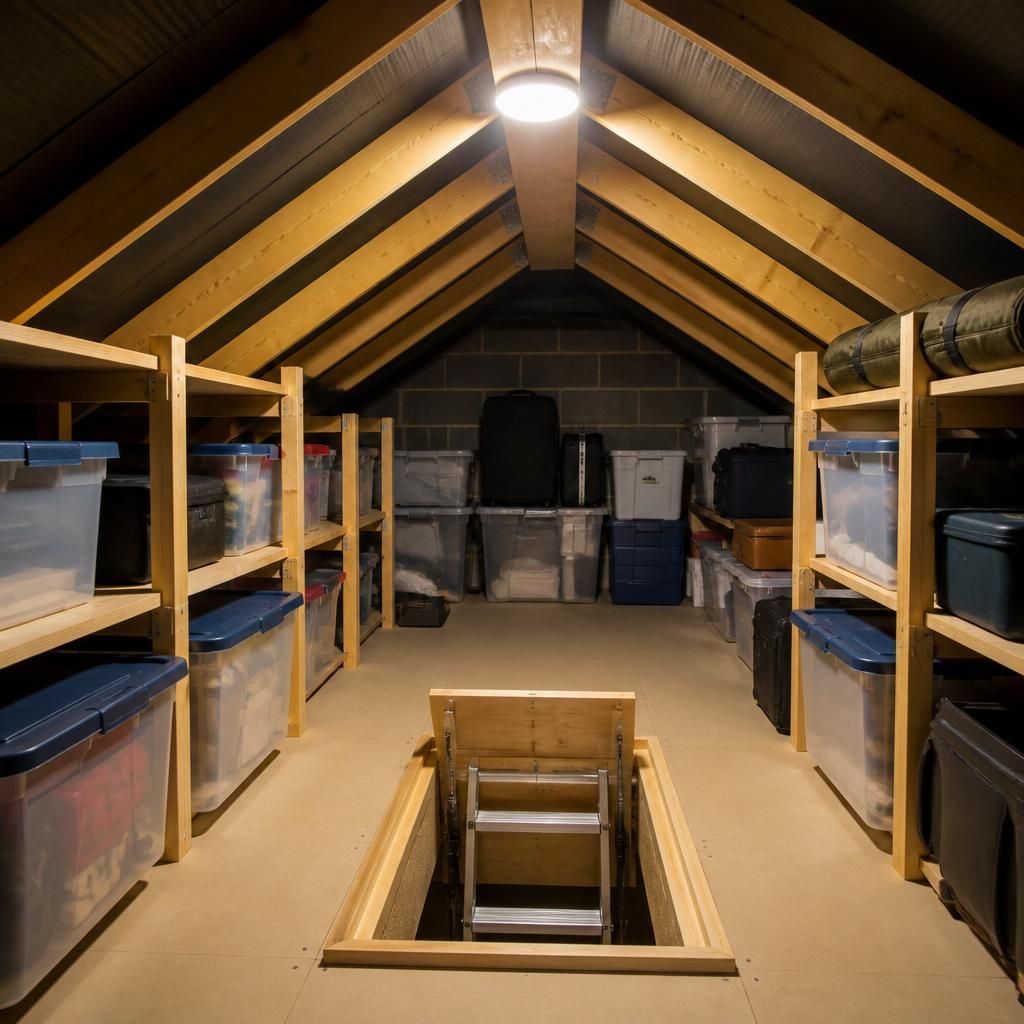
The fitting itself can affect how efficiently you organise the loft. A low-profile light preserves headroom near roof slopes and reduces the chance of catching clothing or boxes during access.
Positioning the fitting above a circulation area, rather than inside a shelving bay, keeps storage faces unobstructed. This arrangement helps you open containers, remove items and adjust shelving without working around the light.