

Can existing downlights remain safe after loft insulation work?
Existing downlights can remain safe after loft insulation work, but this depends on their type, condition, clearance and compatibility with the proposed insulation arrangement. An electrician or suitably qualified professional should assess them before insulation is moved, added or enclosed.
Existing downlights are not automatically unsafe after insulation work. They must remain compatible with the insulation arrangement, retain the required clearance and show no signs of overheating or damage.
A downlight changes the conditions around the ceiling opening. Insulation can restrict heat dissipation, cover the fitting, obstruct a driver or transformer, and make later inspection more difficult. These risks depend on the fitting and installation, rather than the presence of insulation alone.
An electrician should identify the following before insulation is moved or added:
- Fitting type: Older halogen fittings produce substantial heat. LED fittings usually operate differently, but they still require suitable clearance and ventilation.
- Manufacturer instructions: The fitting instructions should confirm whether insulation may meet the light, and what spacing or protective arrangement applies.
- Driver or transformer location: Some LED fittings use separate drivers. These components also require suitable access and heat dissipation.
- Fire protection: Fire-rated downlights depend on their surrounding components and ceiling installation. Removing, covering or altering parts can affect that protection.
- Condition: Discolouration, brittle insulation, loose fittings, damaged cables, flickering or unusual smells require electrical attention before other work continues.
- Switching and dimming: Replacement insulation or LED fittings can expose incompatibility with existing dimmers, transformers or controls.
Insulation should not simply be packed over a downlight because the fitting appears small or runs cool. A suitable arrangement may require a specified clearance, an approved cover or a different insulation layout. The correct choice comes from the fitting instructions and an electrician’s assessment.
Improvised enclosures can create additional problems. A box or cover that is too close, poorly ventilated or not suitable for the fitting may trap heat. It may also interfere with the ceiling’s fire performance or make electrical inspection harder.
LED downlights still need individual assessment. “LED” describes the light source, not every part of the installation. Integrated LED fittings, retrofit lamps and separate drivers can have different requirements. An existing LED fitting may also be unsuitable if its instructions prohibit contact with insulation.
The electrician should also consider the wiring route and electrical connections. Insulation work must not disturb cables, conceal a defect or leave a connection in a position that cannot be inspected as required. Loft insulation installers should not alter electrical fittings unless they hold the appropriate qualifications.
Before work starts, take photographs from the room and loft where safe access allows. Record each downlight position, its fitting type and any driver location. This gives the electrician and insulation installer a shared reference for the proposed arrangement.
After insulation work, the electrician should check that each fitting remains secure, undamaged and correctly connected. The electrician can also confirm that switches, dimmers and protective devices operate correctly. A visual check alone cannot confirm electrical safety.
Tell the installer about any light that has flickered, tripped a circuit, become unusually hot or shown staining. Do not rely on a recent bulb replacement as evidence that the complete fitting is suitable. The fitting, driver, wiring and surrounding ceiling all form part of the assessment.
Loftopia can plan insulation and raised storage around recorded downlight positions, but electrical suitability remains a matter for an electrician. We can use the assessment when arranging the insulation layout and identifying areas that should remain clear.
Do not board over a downlight simply to hide it or create a continuous storage floor. Boarding can reduce access for inspection and place pressure on fittings or cables. A storage layout should leave electrical equipment protected and accessible in line with professional advice.
Where an electrician identifies an unsuitable fitting, replacement or repositioning should take place before insulation and boarding are completed. This avoids enclosing a known defect and reduces the need to disturb finished storage work later.
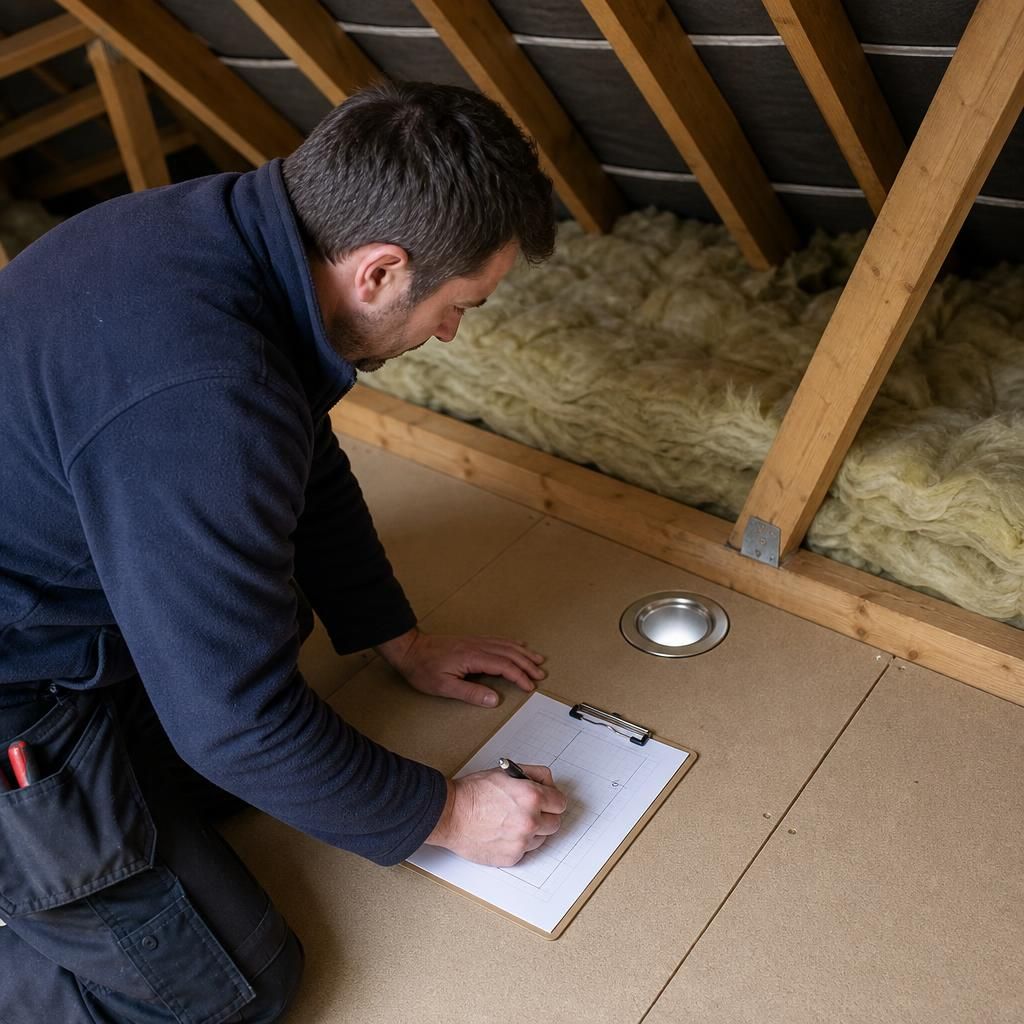
Keep a marked plan of each downlight position after the work is complete. This helps you avoid placing stored items, shelving or later fixings where they could obstruct inspection or disturb the fitting.
Record any areas that require continued clearance, along with the electrician’s advice and the insulation arrangement. If a light later flickers, trips the circuit or shows heat damage, stop using it and arrange an electrical inspection before moving storage or insulation.