

How should loft insulation protect pipes near the eaves?
Loft insulation should reduce heat loss around pipes near the eaves without compressing them or blocking ventilation. Exposed pipework may also need suitable pipe insulation to help reduce freezing risk during cold UK weather.
Loft insulation protects pipes near the eaves by keeping them within a controlled thermal arrangement, while separate pipe insulation limits heat loss from exposed sections. The correct arrangement depends on pipe position, ventilation and access.
Pipework near the eaves is more exposed to cold air than pipework nearer the centre of the loft. Air movement through the roof edge can lower surrounding temperatures, particularly during prolonged cold weather. Insulation therefore needs to protect the pipe without obstructing the ventilation route at the eaves.
Keep the insulation line consistent. Insulation at ceiling level should meet the perimeter carefully, rather than leaving an unprotected strip around the room below. However, it should stop short of covering soffit vents or other designed ventilation openings. Blocking these openings can restrict airflow beneath the roof covering.
Pipe insulation provides the main protection for water pipes located above the insulation layer. It reduces the rate at which pipe contents lose heat and gives the pipe additional protection during cold conditions. The covering should fit the pipe size and remain continuous along exposed runs.
Insulation around a pipe should not be squeezed into a thin layer. Compression reduces its insulating performance and can place pressure on the pipe or its supports. Installers should allow enough room for the pipe covering without forcing loft insulation into the eaves void.
Some pipework may sit partly within the insulation layer and partly within the colder loft space. This transition needs particular care because a short exposed section can remain vulnerable even when most of the pipe is surrounded by insulation. A visual inspection should identify changes in height, direction and exposure.
Do not treat loft insulation as pipe protection on its own. Loose or quilted insulation placed around pipework may move during later access, and it may not provide the close-fitting protection needed around an exposed pipe. Dedicated pipe insulation is more suitable for pipe runs above ceiling-level insulation.
At the eaves, installers should also check that insulation does not interfere with roof timbers, cable routes, pipe supports or access points. Pipework should remain identifiable and reachable for future inspection without disturbing large areas of insulation.
Extra care is appropriate where pipes serve a loft water tank, run close to an external wall or pass through a particularly draughty eaves area. These locations can experience lower temperatures than the main loft space. Additional pipe insulation or a change in pipe routing may be appropriate after inspection.
Pipe protection should not conceal leaks, weakened joints or unsupported sections. Before insulation is completed, check the pipework for visible damage, moisture and movement. A plumber should assess any defect before insulation covers the area.
Loft boarding can make inspection more difficult if it covers pipe routes without planned access. Raised flooring creates storage above insulation, but the layout should retain access to relevant pipework near the eaves. This allows future checks without compressing insulation or dismantling flooring.
Insulation reduces freezing risk, but it cannot guarantee that pipes will never freeze. Severe weather, draughts, low water movement and vulnerable pipe locations can still affect performance. Good protection combines suitable pipe insulation, a correctly arranged loft insulation layer and unobstructed eaves ventilation.
During a loft assessment, we can review the relationship between the insulation, pipework and roof-edge ventilation. We can then explain where pipe insulation, repositioning, access measures or raised flooring may be appropriate.
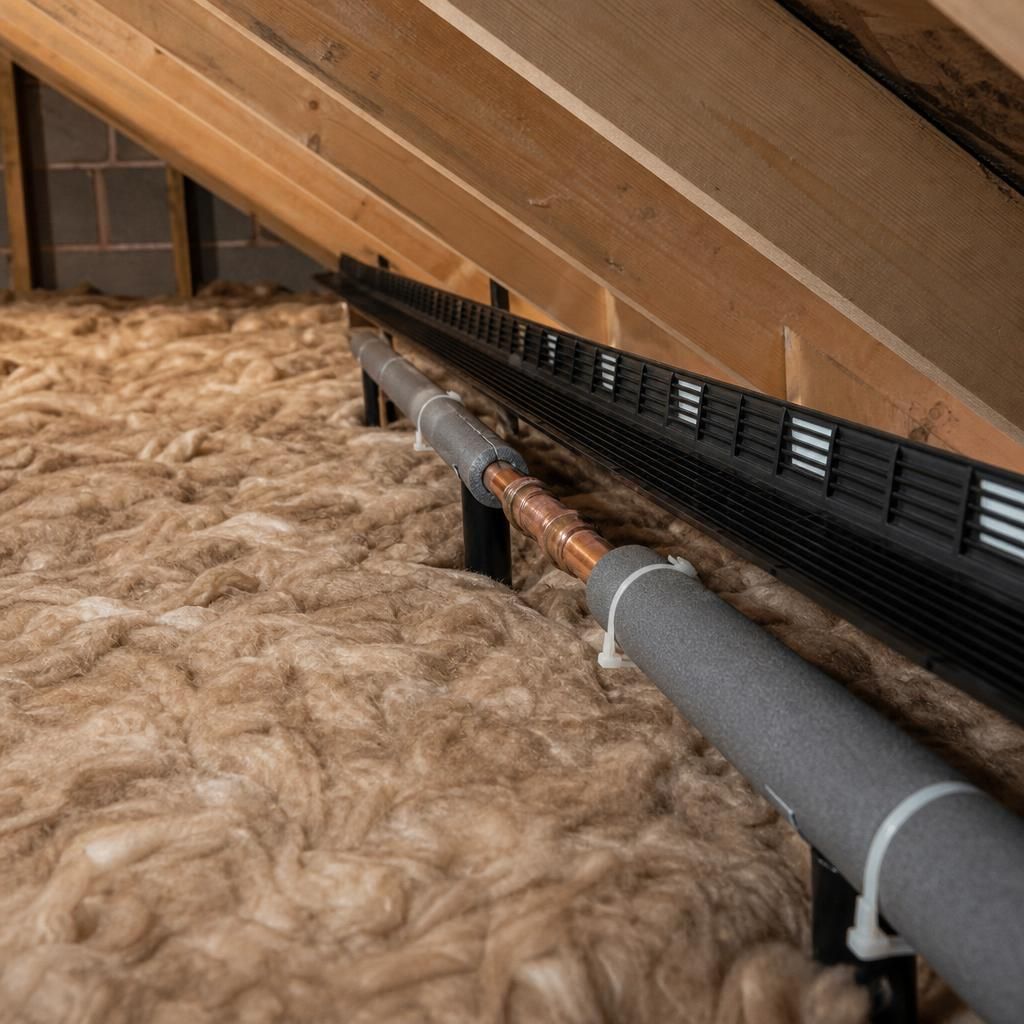
At the eaves, a ventilation tray or baffle can hold loft insulation back from the roof-edge airflow route. This helps maintain ventilation while keeping the insulation line continuous behind it.
The tray should not press against pipework or restrict access. We check that pipe insulation remains intact where the pipe passes beside the tray, with no sharp edges or displaced material creating pressure.