
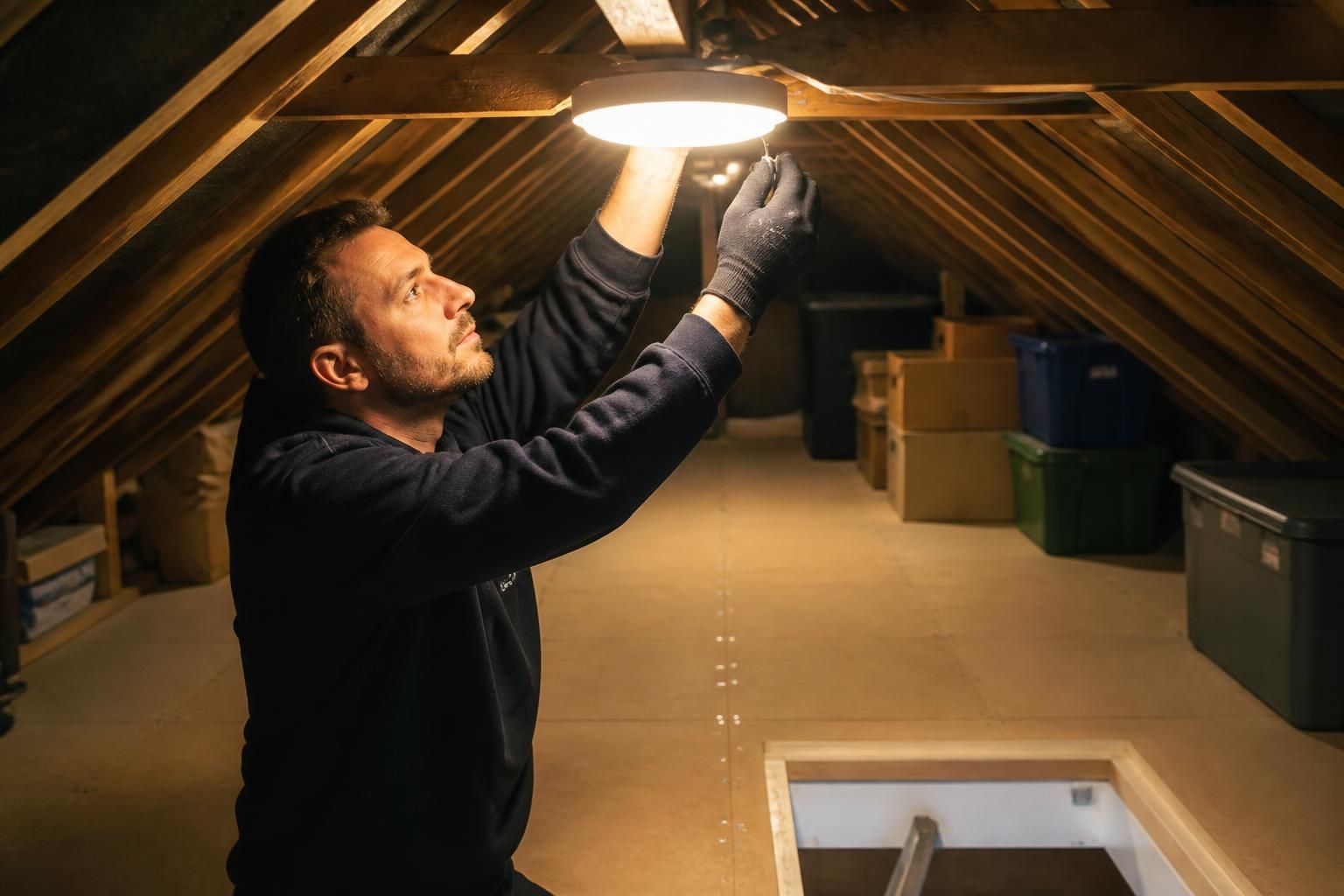
Can loft lighting be replaced without disturbing the boarding?
Loft lighting can often be replaced without disturbing the wider boarding. We check the fitting, wiring and access before removing only the sections needed, protecting the raised flooring and insulation during the work.
In many cases, a loft light can be replaced without lifting the wider boarded area. The work depends on the fitting, cable route, access around the light and how the boarding was constructed.
A same-position replacement usually causes the least disruption. We first identify the existing fitting and confirm how it is supported. We also check whether the cable enters from above, below or through an opening in the raised flooring. This determines whether the fitting can be removed from the accessible surface.
Before electrical work begins, a suitably qualified electrician should isolate the relevant circuit and verify that it is safe. The electrician can then disconnect the old fitting, inspect the connections and install the replacement. Testing after installation confirms that the light operates correctly and that the circuit remains safe.
Existing boarding does not always need to be removed. If the fitting can be reached from an existing access point, the electrician may work within that opening. Where a small section must be lifted, we mark the area carefully and remove only the boards needed for access.
LoftZone raised flooring is designed to provide storage above insulation. Work must therefore avoid crushing the insulation beneath the raised deck. We protect exposed insulation while boards are lifted and keep loose materials away from the insulation and roof structure.
The way the light is mounted also affects the work. Surface-mounted fittings may attach to a suitable support above the boarding. Recessed fittings need a correctly sized opening and adequate clearance around the fitting. The electrician must follow the fitting manufacturer’s instructions and account for heat, wiring and surrounding materials.
Some fittings require additional protection from stored items or accidental impact. We assess the position of the light against the storage layout. A fitting positioned beneath boxes, shelving or a frequently used access route may need a guard or a revised position.
We also check that the replacement does not obstruct roof ventilation or interfere with other loft components. Cables should remain supported and protected from damage. We do not place wiring where stored items could snag, crush or pull it away from its connections.
If boarding has been fixed over the cable route, removing a larger section may be necessary. We explain the access needed before work starts rather than forcing boards or cutting through areas containing unknown services. This reduces the risk of damaging the flooring, wiring or insulation.
After the replacement, we refit any lifted boards securely. We check that supports remain properly seated and that the finished surface has no loose edges or avoidable trip points. A small access panel can sometimes provide useful future access, depending on the layout and the position of the wiring.
Replacing a light can reveal related issues, such as an unsuitable fitting, damaged cable, poor support or an earlier alteration that does not meet current requirements. These matters should be assessed before the new light is connected. An electrician may recommend further work if the existing wiring cannot safely support the replacement.
Loftopia can assess the boarding, insulation, access and lighting position together. That assessment helps establish whether the replacement can stay in place, needs a small access opening or requires more careful work around the raised flooring.

Replacing a lamp or LED module is different from replacing the complete light fitting. A removable lamp can usually be changed from the visible face, without disturbing the boarding.
Integrated LED fittings normally require the whole unit to be removed. We check the mounting method and connection point before selecting a replacement that fits the existing opening. Keeping the same position and compatible dimensions can limit work to the fitting itself.
Where future access matters, we can discuss a fitting arrangement that leaves connections reachable from an existing access point. This helps avoid unnecessary lifting of raised flooring during later maintenance.